Cashless festival payments that work on someone’s first shift
A wallet, a till and an organiser portal, built for festivals of 500 to 20,000 people.
Piek replaced plastic festival tokens with a digital wallet for visitors, a till for vendors and a portal for organisers. I was the only designer in a team of two at Doordacht, alongside the CEO. Move4Mobile (now Framna Zwolle) built and maintained the app. Piek ran at about 50 festivals between 2019 and 2021. Vendors were set up in minutes, and the two support colleagues we sent to festivals often ended up on the dancefloor because there was so little left for them to do.
Full plate
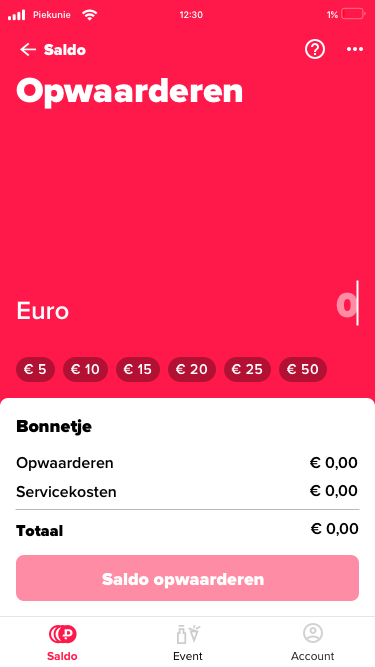
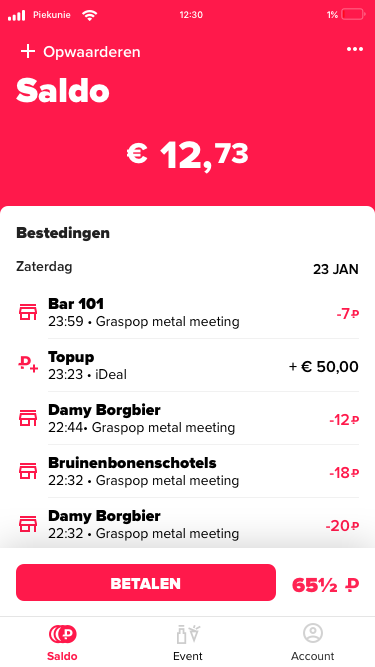
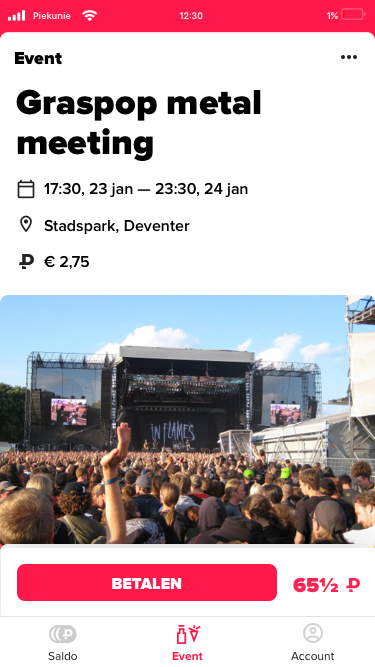
One system in three places: the visitor's wallet, the vendor's till, and the organiser's portal.

The problem
Most small festivals worked with cash or plastic tokens in a closed loop. Tokens are wasteful, so many organisers were looking for a digital alternative. Vendors, often volunteers, still had to learn a second system for a single weekend. Local festivals have no IT team, so whatever replaced the tokens had to work without setup, training or someone standing next to it.
We spoke to many organisers and vendors about accuracy of data and speed. Long lines at the token tills showed us an opportunity: a simple system that removed the discussions and the queues.
The till is a calculator
Vendors already had a way of working. They did the maths in their heads, took the money and gave change. So the first till copied that. You type the amount, press enter and scan the visitor, the same as cash but with digital coins.
Early on, few vendors used the product catalogue. They weren’t prepared to enter every product, and they didn’t need to. Most brought pen and paper, wrote down the number of digital tokens per item, and let the till add it up. A calculator asked for nothing, so a vendor could start selling straight away.
Later, vendors could add products and prices on their festival page, but it stayed basic. Once a festival started they were too busy selling to look at it, and they kept using the calculator out of habit. So we never went down the POS-style tabs route. The trade-off was that we had little per-product data.
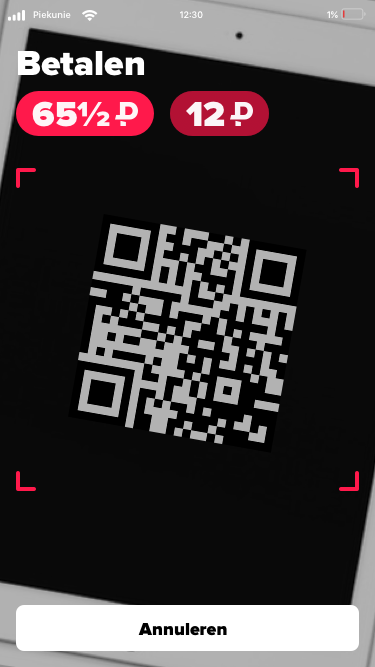
Visitors could pay with a QR code in the app, or by tapping a phone, NFC card or wristband on the same till. Some organisers didn’t want visitors to need phones or apps at all and just wanted wristbands, so the till had to support every option.
When a balance was too low, the till showed the exact amount missing, so the vendor could say “you’re three euros short” without guessing or retrying. App users saw the problem on their own phone and could top up on the spot. Wristbands and cards have no screen, so for those visitors the till had to carry the whole message.
5 details
Drag sideways →
The portal an organiser watches during an event: revenue and top-ups split by payment method, transactions over the duration, and every point of sale with its tills.

Getting a festival live
Onboarding a new organiser took some work, because Piek effectively worked as a short-term bank. Organisers first had to be verified by the bank. After that, setup was quick:
- Set up the account.
- Add the vendors they regularly work with, so these carry over between events. Some simply added “vendor 1 to 10”.
- Set up the event.
We set up the first events together with each new organiser so they could see how it worked. They could then track all the analytics for the event. Vendors received a share link and could choose to share their figures with the organiser, or just be included in the grand total. Because we were the middleman, organisers had no say in what vendors earned beyond the totals to be paid out.
What I designed but couldn’t prove
Festival fields have poor signal, so each till kept the last known balance of every visitor and only approved sales that fit inside it. Whenever tills were online they checked balances against our database, which kept them in sync with the app. In our tests the connection never dropped, and offline mode never came up in the field.
The gap: if two tills were offline at the same time, a visitor could spend the same balance at both. We judged that unlikely, and it never happened.
I see this as a business decision about acceptable risk more than a design one. Design can make a limit visible, but how much risk to accept isn’t a design call.
What happened to Piek
The initial investors wanted to sell after they saw our ask drop and the price of card transactions halve within six months. The cost of PIN terminals was irrelevant. It was the transaction fees that made a closed payment system hard to justify.